Sermon
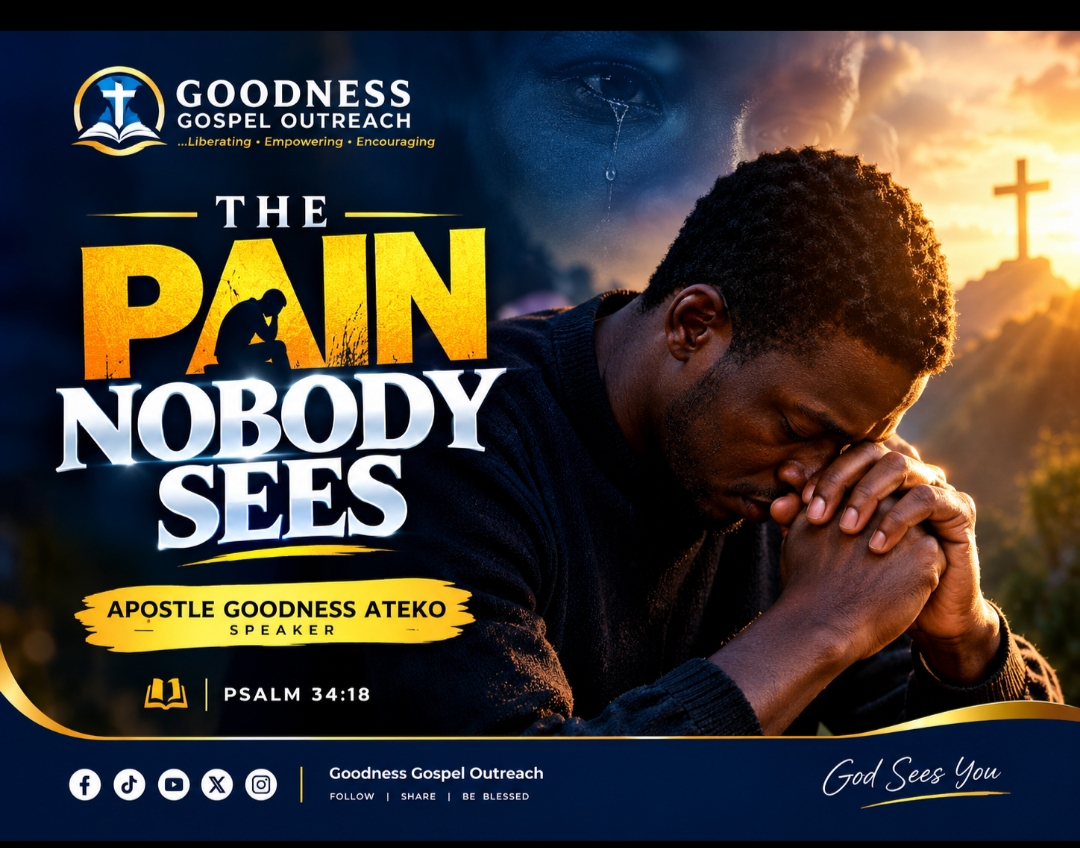
The Pain Nobody Sees
Scripture: Psalm 34:18; 2 Corinthians 4:8-9; 1 Kings 19:1-18
A biblical message about hidden wounds, silent battles, emotional exhaustion, rejection and loneliness. Through Hagar, Elijah, David and Jesus, it shows that God sees what people cannot see.
THE PAIN NOBODY SEES
An Apostolic Fire Sermon
Speaker: Apostle Goodness Ateko
Primary Scriptures: Psalm 34:18; 2 Corinthians 4:8–9; 1 Kings 19:1–18
Supporting Scriptures: Genesis 16:13; Psalm 42:5; Matthew 11:28; Hebrews 4:15–16; John 11:35; Isaiah 43:2
SERMON DESCRIPTION
There is a kind of pain that does not appear on the face. It does not require a bandage, and sometimes nobody around you knows that you are fighting to remain standing.
Some people are smiling while their hearts are bleeding. Some are serving while secretly exhausted. Some encourage others while they themselves need encouragement. Some pray for everyone but struggle to find words for their own pain.
The Pain Nobody Sees is a powerful biblical message about hidden wounds, silent battles, emotional exhaustion, disappointment, rejection, loneliness and the burdens people carry behind their public appearance.
Through the lives of Elijah, Hagar, David and Jesus, this message reveals that God sees what people cannot see. Hidden pain is not hidden from God. The God who sees you can restore you, strengthen you and bring you through the place where you thought you would break.
THE SERMON
TEXT: PSALM 34:18
“The LORD is nigh unto them that are of a broken heart; and saveth such as be of a contrite spirit.”
There is pain that people can see.
There is also pain that nobody sees.
There is physical pain that can be diagnosed.
There is emotional pain that may have no visible wound.
There is financial pressure that people conceal.
There is disappointment that never reaches social media.
There is rejection that happened years ago but still speaks inside someone's heart.
There is the pain of praying and waiting.
The pain of watching others advance while you seem to be standing still.
The pain of being strong for everybody while secretly asking, “Lord, who will strengthen me?”
And sometimes the most dangerous pain is not the pain everybody knows about.
It is the pain nobody knows exists.
But hear this word:
People may not see your pain, but God does.
1. NOT EVERY SMILE MEANS EVERYTHING IS WELL
We live in a generation where people have learned how to present themselves.
A person can post:
“God is good!”
while crying privately.
Someone can preach about faith and still be fighting discouragement.
Someone can encourage others while desperately needing encouragement themselves.
Someone can appear successful while carrying a private battle.
The danger is that we sometimes judge people's condition by their appearance.
But God does not merely look at the appearance.
1 Samuel 16:7 reminds us that while human beings look at the outward appearance, the Lord looks at the heart.
That means you cannot always understand a person's battle by looking at their face.
Some battles are invisible.
Some tears are internal.
Some wounds are hidden beneath years of silence.
Some people don't need condemnation.
They need restoration.
Some don't need another person telling them, “Be strong.”
They need someone to remind them:
“You don't have to pretend before God.”
2. HAGAR: GOD SEES THE PERSON OTHERS OVERLOOKED
Consider Hagar.
She was rejected, displaced and found herself in the wilderness.
Genesis 16:6–13 records her encounter with God.
And after God spoke to her, Hagar called Him:
“Thou God seest me.”
— Genesis 16:13
What a revelation!
She discovered something powerful:
God saw her when people did not.
She was in a wilderness, but she was not invisible.
She was rejected, but she was not forgotten.
She was displaced, but she was not abandoned.
There are seasons when your environment may make you feel invisible.
You may say:
“Nobody understands what I am going through.”
But God says:
“I see you.”
I see the tears you wiped before anybody entered the room.
I see the prayers you prayed when you had no strength.
I see the disappointment you never discussed.
I see the battle behind your silence.
I see the sacrifice nobody celebrated.
You are not invisible to God.
3. ELIJAH: EVEN GREAT PEOPLE CAN BECOME EXHAUSTED
One of the most powerful examples of hidden pain is Elijah.
In 1 Kings 18, Elijah stood publicly in a dramatic confrontation on Mount Carmel.
Fire fell.
The people witnessed the manifestation of God's power.
Elijah appeared fearless.
But immediately afterward, something changed.
In 1 Kings 19:4, Elijah went into the wilderness and prayed that he might die.
Think about that.
The man who had just stood publicly in one of the greatest moments of his prophetic ministry was now privately overwhelmed.
Public victory did not automatically eliminate private exhaustion.
This is important.
You can have a testimony and still need restoration.
You can experience God's power and still become tired.
You can be used by God and still require care.
You can be strong in one season and exhausted in another.
And notice how God responded to Elijah.
God did not begin by condemning him.
God gave him rest and nourishment.
Then God dealt with him.
There is a lesson here:
Sometimes what looks like spiritual weakness is also human exhaustion.
We must be careful not to spiritualize everything.
Sometimes people need prayer.
Sometimes they also need rest, wise counsel, healthy relationships and appropriate professional help.
Biblical spirituality does not require pretending that human beings have no limits.
4. GOD DOES NOT DESPISE THE BROKENHEARTED
Psalm 34:18 says:
“The LORD is nigh unto them that are of a broken heart.”
Notice the language:
Not merely, “God remembers them.”
It says:
“The LORD is nigh.”
God draws near to the brokenhearted.
Your brokenness does not repel God.
Your tears do not frighten God.
Your questions do not make God abandon you.
Your weakness does not make Him lose interest in you.
There are moments when you cannot explain what you feel.
You simply know:
“Something inside me hurts.”
You may not even have the vocabulary for the pain.
But God understands the language of the heart.
5. DAVID KNEW WHAT IT MEANT TO HURT IN SILENCE
David was a worshipper, warrior and king.
But read the Psalms carefully.
You will discover a man who knew pain.
Psalm 42:5 says:
“Why art thou cast down, O my soul? and why art thou disquieted in me?”
David was talking to his own soul.
There were moments when his external circumstances and internal condition were completely different.
He could lead people publicly while wrestling privately.
This teaches us something important:
Being a person of faith does not mean you never experience emotional distress.
Faith means you do not allow the distress to become the final voice.
David asked questions.
David cried.
David lamented.
David remembered.
And David returned to hope.
He said:
“Hope thou in God.”
That is the movement of biblical lament:
Pain → honesty → remembrance → faith → hope.
God does not require you to lie about your pain in order to demonstrate faith.
6. JESUS ALSO ENTERED A PLACE OF DEEP SORROW
Look at Jesus in Gethsemane.
Matthew 26:38 records His words:
“My soul is exceeding sorrowful, even unto death.”
Jesus knew what it meant to carry overwhelming sorrow.
He prayed.
He submitted Himself to the Father.
He did not pretend that the moment was easy.
And Hebrews 4:15 tells us that we have a High Priest who can sympathize with our weaknesses.
This means when you are hurting, you are not praying to a God who has no understanding of suffering.
Jesus understands the weight of sorrow.
He understands betrayal.
He understands rejection.
He understands loneliness.
He understands tears.
He understands the burden of obedience.
He understands Gethsemane.
Therefore:
You can come boldly to the throne of grace.
— Hebrews 4:16
Not because you have everything together.
But because mercy is available.
7. THE PAIN MAY BE HIDDEN FROM PEOPLE, BUT IT IS NOT HIDDEN FROM GOD
There are four things I want you to remember.
1. God sees your tears.
Psalm 56:8 speaks of God keeping account of tears.
Your tears are not wasted.
2. God hears your prayers.
Psalm 34:17 says:
“The righteous cry, and the LORD heareth.”
Your prayer may feel unanswered, but silence is not proof that God is absent.
3. God knows your heart.
Psalm 139:1–4 presents God as the One who searches and knows us.
You don't have to explain everything perfectly to God.
4. God can restore what pain damaged.
Psalm 147:3 says:
“He healeth the broken in heart, and bindeth up their wounds.”
The God who sees the wound also knows how to bind it.
8. DO NOT BUILD YOUR IDENTITY AROUND YOUR WOUND
This is where apostolic fire must confront the enemy.
Your pain is real.
But your pain is not your identity.
You may have been rejected.
But you are not rejection.
You may have failed.
But you are not failure.
You may have experienced disappointment.
But disappointment does not define your destiny.
You may have lost something.
But loss does not mean your entire future is lost.
The wound is part of your story; it is not the conclusion of your story.
Joseph was betrayed, but betrayal did not become his identity.
David was pursued, but persecution did not become his identity.
Hagar was abandoned, but abandonment did not become her identity.
Elijah became exhausted, but exhaustion did not terminate his prophetic assignment.
Peter failed Jesus, but failure did not become the end of his ministry.
Your present pain is not necessarily your final chapter.
9. WHAT SHOULD YOU DO WITH THE PAIN NOBODY SEES?
A. BRING IT TO GOD
Stop hiding from the One who already knows.
Psalm 62:8 says:
“Trust in him at all times; ye people, pour out your heart before him.”
Pour it out.
Not perform it.
Not disguise it.
Pour it out.
Tell God what hurts.
Tell Him where you are confused.
Tell Him what you fear.
Tell Him where you are tired.
B. STOP PRETENDING THAT YOU ARE INVINCIBLE
You are human.
Even Elijah needed rest.
Even David had moments of distress.
Even Jesus wept.
John 11:35 simply says:
“Jesus wept.”
There is no shame in tears.
Tears do not automatically mean unbelief.
Sometimes tears are evidence that something mattered deeply.
C. ALLOW TRUSTED PEOPLE INTO YOUR STORY
Galatians 6:2 says:
“Bear ye one another's burdens.”
God did not design us to carry every burden alone.
There are moments when you need a mature believer.
There are moments when you need a pastor.
There are moments when you need a trusted friend.
And there are situations where seeking qualified mental-health or medical support is appropriate.
Seeking help is not a denial of faith.
Wisdom is also spiritual.
10. YOUR PAIN CAN BECOME A PLACE OF ENCOUNTER
I am not saying that God caused every painful experience.
I am saying that God can meet you in painful places.
The wilderness became a place where Hagar encountered God.
The cave became a place where Elijah encountered God's voice.
The prison became part of Joseph's journey toward his assignment.
Gethsemane became the place where Jesus surrendered His will to the Father.
Therefore:
Do not waste your pain.
Let God teach you through it.
Let Him heal you through it.
Let Him deepen your compassion through it.
Let Him make you wiser through it.
Let Him turn your testimony into encouragement for someone else.
But don't glorify the wound.
Let God receive the wound and produce redemption from the story.
APOSTOLIC DECLARATIONS
If you are able, lift your hands and declare:
I will not die in the place of my pain.
My pain will not become my identity.
My wounds will not cancel my assignment.
What people cannot see, God sees.
What people cannot understand, God understands.
The Lord is near to me.
The Lord is healing my broken heart.
The Lord is strengthening my weak places.
I receive grace to continue.
I receive wisdom to seek help where help is needed.
I receive courage to confront what I have been hiding.
I will not surrender my future because of my present pain.
My tears will not be the end of my story.
By the grace of God, I will arise again.
PRAYER OF RESTORATION
Father, in the name of Jesus Christ,
I bring before You every hidden pain.
Every wound that has been concealed.
Every disappointment that has been buried.
Every rejection that still speaks.
Every secret battle.
Every silent tear.
Every exhaustion.
Every fear.
Every grief.
Every burden that Your children have carried alone.
Lord, let Your healing presence enter those places.
Where there is brokenness, bring restoration.
Where there is confusion, bring light.
Where there is exhaustion, bring strength.
Where there is grief, bring comfort.
Where there is rejection, establish identity.
Where there is fear, release courage.
Where there is hopelessness, restore hope.
Give Your people grace to speak when they need help.
Give them wisdom to recognize healthy support.
Give them strength to continue.
And where the enemy has used pain to convince someone that their story is finished, let the light of Your Word arise again.
According to Psalm 34:18, draw near to the brokenhearted.
According to Psalm 147:3, heal their wounds.
According to Isaiah 43:2, let them know that when they pass through the waters, You are with them.
And according to Hebrews 4:16, let them approach Your throne with confidence to receive mercy and grace.
In the name of Jesus Christ. Amen.
ALTAR CALL — “COME OUT OF HIDING”
If you have been carrying a pain nobody sees, today you don't have to carry it alone.
You may have been strong for everybody.
You may have encouraged everybody.
You may have prayed for everybody.
But today, let God minister to you.
Come to Jesus.
Bring Him the wound.
Bring Him the disappointment.
Bring Him the questions.
Bring Him the tears.
Bring Him the burden.
Jesus said in Matthew 11:28:
“Come unto me, all ye that labour and are heavy laden, and I will give you rest.”
The invitation is still open.
The pain may be hidden from people—but it is not hidden from God.
And the God who sees you has not abandoned you.
Arise again.
Heal again.
Believe again.
Pray again.
Serve again.
Live again.
There is still purpose ahead of you.
An Apostolic Fire Sermon
Speaker: Apostle Goodness Ateko
Primary Scriptures: Psalm 34:18; 2 Corinthians 4:8–9; 1 Kings 19:1–18
Supporting Scriptures: Genesis 16:13; Psalm 42:5; Matthew 11:28; Hebrews 4:15–16; John 11:35; Isaiah 43:2
SERMON DESCRIPTION
There is a kind of pain that does not appear on the face. It does not require a bandage, and sometimes nobody around you knows that you are fighting to remain standing.
Some people are smiling while their hearts are bleeding. Some are serving while secretly exhausted. Some encourage others while they themselves need encouragement. Some pray for everyone but struggle to find words for their own pain.
The Pain Nobody Sees is a powerful biblical message about hidden wounds, silent battles, emotional exhaustion, disappointment, rejection, loneliness and the burdens people carry behind their public appearance.
Through the lives of Elijah, Hagar, David and Jesus, this message reveals that God sees what people cannot see. Hidden pain is not hidden from God. The God who sees you can restore you, strengthen you and bring you through the place where you thought you would break.
THE SERMON
TEXT: PSALM 34:18
“The LORD is nigh unto them that are of a broken heart; and saveth such as be of a contrite spirit.”
There is pain that people can see.
There is also pain that nobody sees.
There is physical pain that can be diagnosed.
There is emotional pain that may have no visible wound.
There is financial pressure that people conceal.
There is disappointment that never reaches social media.
There is rejection that happened years ago but still speaks inside someone's heart.
There is the pain of praying and waiting.
The pain of watching others advance while you seem to be standing still.
The pain of being strong for everybody while secretly asking, “Lord, who will strengthen me?”
And sometimes the most dangerous pain is not the pain everybody knows about.
It is the pain nobody knows exists.
But hear this word:
People may not see your pain, but God does.
1. NOT EVERY SMILE MEANS EVERYTHING IS WELL
We live in a generation where people have learned how to present themselves.
A person can post:
“God is good!”
while crying privately.
Someone can preach about faith and still be fighting discouragement.
Someone can encourage others while desperately needing encouragement themselves.
Someone can appear successful while carrying a private battle.
The danger is that we sometimes judge people's condition by their appearance.
But God does not merely look at the appearance.
1 Samuel 16:7 reminds us that while human beings look at the outward appearance, the Lord looks at the heart.
That means you cannot always understand a person's battle by looking at their face.
Some battles are invisible.
Some tears are internal.
Some wounds are hidden beneath years of silence.
Some people don't need condemnation.
They need restoration.
Some don't need another person telling them, “Be strong.”
They need someone to remind them:
“You don't have to pretend before God.”
2. HAGAR: GOD SEES THE PERSON OTHERS OVERLOOKED
Consider Hagar.
She was rejected, displaced and found herself in the wilderness.
Genesis 16:6–13 records her encounter with God.
And after God spoke to her, Hagar called Him:
“Thou God seest me.”
— Genesis 16:13
What a revelation!
She discovered something powerful:
God saw her when people did not.
She was in a wilderness, but she was not invisible.
She was rejected, but she was not forgotten.
She was displaced, but she was not abandoned.
There are seasons when your environment may make you feel invisible.
You may say:
“Nobody understands what I am going through.”
But God says:
“I see you.”
I see the tears you wiped before anybody entered the room.
I see the prayers you prayed when you had no strength.
I see the disappointment you never discussed.
I see the battle behind your silence.
I see the sacrifice nobody celebrated.
You are not invisible to God.
3. ELIJAH: EVEN GREAT PEOPLE CAN BECOME EXHAUSTED
One of the most powerful examples of hidden pain is Elijah.
In 1 Kings 18, Elijah stood publicly in a dramatic confrontation on Mount Carmel.
Fire fell.
The people witnessed the manifestation of God's power.
Elijah appeared fearless.
But immediately afterward, something changed.
In 1 Kings 19:4, Elijah went into the wilderness and prayed that he might die.
Think about that.
The man who had just stood publicly in one of the greatest moments of his prophetic ministry was now privately overwhelmed.
Public victory did not automatically eliminate private exhaustion.
This is important.
You can have a testimony and still need restoration.
You can experience God's power and still become tired.
You can be used by God and still require care.
You can be strong in one season and exhausted in another.
And notice how God responded to Elijah.
God did not begin by condemning him.
God gave him rest and nourishment.
Then God dealt with him.
There is a lesson here:
Sometimes what looks like spiritual weakness is also human exhaustion.
We must be careful not to spiritualize everything.
Sometimes people need prayer.
Sometimes they also need rest, wise counsel, healthy relationships and appropriate professional help.
Biblical spirituality does not require pretending that human beings have no limits.
4. GOD DOES NOT DESPISE THE BROKENHEARTED
Psalm 34:18 says:
“The LORD is nigh unto them that are of a broken heart.”
Notice the language:
Not merely, “God remembers them.”
It says:
“The LORD is nigh.”
God draws near to the brokenhearted.
Your brokenness does not repel God.
Your tears do not frighten God.
Your questions do not make God abandon you.
Your weakness does not make Him lose interest in you.
There are moments when you cannot explain what you feel.
You simply know:
“Something inside me hurts.”
You may not even have the vocabulary for the pain.
But God understands the language of the heart.
5. DAVID KNEW WHAT IT MEANT TO HURT IN SILENCE
David was a worshipper, warrior and king.
But read the Psalms carefully.
You will discover a man who knew pain.
Psalm 42:5 says:
“Why art thou cast down, O my soul? and why art thou disquieted in me?”
David was talking to his own soul.
There were moments when his external circumstances and internal condition were completely different.
He could lead people publicly while wrestling privately.
This teaches us something important:
Being a person of faith does not mean you never experience emotional distress.
Faith means you do not allow the distress to become the final voice.
David asked questions.
David cried.
David lamented.
David remembered.
And David returned to hope.
He said:
“Hope thou in God.”
That is the movement of biblical lament:
Pain → honesty → remembrance → faith → hope.
God does not require you to lie about your pain in order to demonstrate faith.
6. JESUS ALSO ENTERED A PLACE OF DEEP SORROW
Look at Jesus in Gethsemane.
Matthew 26:38 records His words:
“My soul is exceeding sorrowful, even unto death.”
Jesus knew what it meant to carry overwhelming sorrow.
He prayed.
He submitted Himself to the Father.
He did not pretend that the moment was easy.
And Hebrews 4:15 tells us that we have a High Priest who can sympathize with our weaknesses.
This means when you are hurting, you are not praying to a God who has no understanding of suffering.
Jesus understands the weight of sorrow.
He understands betrayal.
He understands rejection.
He understands loneliness.
He understands tears.
He understands the burden of obedience.
He understands Gethsemane.
Therefore:
You can come boldly to the throne of grace.
— Hebrews 4:16
Not because you have everything together.
But because mercy is available.
7. THE PAIN MAY BE HIDDEN FROM PEOPLE, BUT IT IS NOT HIDDEN FROM GOD
There are four things I want you to remember.
1. God sees your tears.
Psalm 56:8 speaks of God keeping account of tears.
Your tears are not wasted.
2. God hears your prayers.
Psalm 34:17 says:
“The righteous cry, and the LORD heareth.”
Your prayer may feel unanswered, but silence is not proof that God is absent.
3. God knows your heart.
Psalm 139:1–4 presents God as the One who searches and knows us.
You don't have to explain everything perfectly to God.
4. God can restore what pain damaged.
Psalm 147:3 says:
“He healeth the broken in heart, and bindeth up their wounds.”
The God who sees the wound also knows how to bind it.
8. DO NOT BUILD YOUR IDENTITY AROUND YOUR WOUND
This is where apostolic fire must confront the enemy.
Your pain is real.
But your pain is not your identity.
You may have been rejected.
But you are not rejection.
You may have failed.
But you are not failure.
You may have experienced disappointment.
But disappointment does not define your destiny.
You may have lost something.
But loss does not mean your entire future is lost.
The wound is part of your story; it is not the conclusion of your story.
Joseph was betrayed, but betrayal did not become his identity.
David was pursued, but persecution did not become his identity.
Hagar was abandoned, but abandonment did not become her identity.
Elijah became exhausted, but exhaustion did not terminate his prophetic assignment.
Peter failed Jesus, but failure did not become the end of his ministry.
Your present pain is not necessarily your final chapter.
9. WHAT SHOULD YOU DO WITH THE PAIN NOBODY SEES?
A. BRING IT TO GOD
Stop hiding from the One who already knows.
Psalm 62:8 says:
“Trust in him at all times; ye people, pour out your heart before him.”
Pour it out.
Not perform it.
Not disguise it.
Pour it out.
Tell God what hurts.
Tell Him where you are confused.
Tell Him what you fear.
Tell Him where you are tired.
B. STOP PRETENDING THAT YOU ARE INVINCIBLE
You are human.
Even Elijah needed rest.
Even David had moments of distress.
Even Jesus wept.
John 11:35 simply says:
“Jesus wept.”
There is no shame in tears.
Tears do not automatically mean unbelief.
Sometimes tears are evidence that something mattered deeply.
C. ALLOW TRUSTED PEOPLE INTO YOUR STORY
Galatians 6:2 says:
“Bear ye one another's burdens.”
God did not design us to carry every burden alone.
There are moments when you need a mature believer.
There are moments when you need a pastor.
There are moments when you need a trusted friend.
And there are situations where seeking qualified mental-health or medical support is appropriate.
Seeking help is not a denial of faith.
Wisdom is also spiritual.
10. YOUR PAIN CAN BECOME A PLACE OF ENCOUNTER
I am not saying that God caused every painful experience.
I am saying that God can meet you in painful places.
The wilderness became a place where Hagar encountered God.
The cave became a place where Elijah encountered God's voice.
The prison became part of Joseph's journey toward his assignment.
Gethsemane became the place where Jesus surrendered His will to the Father.
Therefore:
Do not waste your pain.
Let God teach you through it.
Let Him heal you through it.
Let Him deepen your compassion through it.
Let Him make you wiser through it.
Let Him turn your testimony into encouragement for someone else.
But don't glorify the wound.
Let God receive the wound and produce redemption from the story.
APOSTOLIC DECLARATIONS
If you are able, lift your hands and declare:
I will not die in the place of my pain.
My pain will not become my identity.
My wounds will not cancel my assignment.
What people cannot see, God sees.
What people cannot understand, God understands.
The Lord is near to me.
The Lord is healing my broken heart.
The Lord is strengthening my weak places.
I receive grace to continue.
I receive wisdom to seek help where help is needed.
I receive courage to confront what I have been hiding.
I will not surrender my future because of my present pain.
My tears will not be the end of my story.
By the grace of God, I will arise again.
PRAYER OF RESTORATION
Father, in the name of Jesus Christ,
I bring before You every hidden pain.
Every wound that has been concealed.
Every disappointment that has been buried.
Every rejection that still speaks.
Every secret battle.
Every silent tear.
Every exhaustion.
Every fear.
Every grief.
Every burden that Your children have carried alone.
Lord, let Your healing presence enter those places.
Where there is brokenness, bring restoration.
Where there is confusion, bring light.
Where there is exhaustion, bring strength.
Where there is grief, bring comfort.
Where there is rejection, establish identity.
Where there is fear, release courage.
Where there is hopelessness, restore hope.
Give Your people grace to speak when they need help.
Give them wisdom to recognize healthy support.
Give them strength to continue.
And where the enemy has used pain to convince someone that their story is finished, let the light of Your Word arise again.
According to Psalm 34:18, draw near to the brokenhearted.
According to Psalm 147:3, heal their wounds.
According to Isaiah 43:2, let them know that when they pass through the waters, You are with them.
And according to Hebrews 4:16, let them approach Your throne with confidence to receive mercy and grace.
In the name of Jesus Christ. Amen.
ALTAR CALL — “COME OUT OF HIDING”
If you have been carrying a pain nobody sees, today you don't have to carry it alone.
You may have been strong for everybody.
You may have encouraged everybody.
You may have prayed for everybody.
But today, let God minister to you.
Come to Jesus.
Bring Him the wound.
Bring Him the disappointment.
Bring Him the questions.
Bring Him the tears.
Bring Him the burden.
Jesus said in Matthew 11:28:
“Come unto me, all ye that labour and are heavy laden, and I will give you rest.”
The invitation is still open.
The pain may be hidden from people—but it is not hidden from God.
And the God who sees you has not abandoned you.
Arise again.
Heal again.
Believe again.
Pray again.
Serve again.
Live again.
There is still purpose ahead of you.